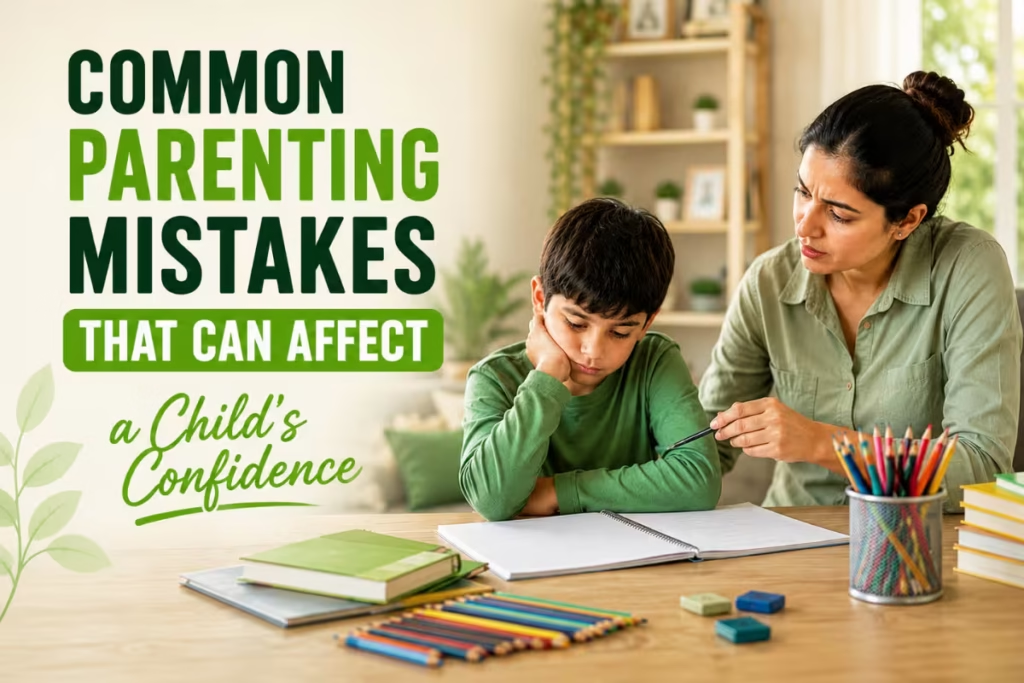
Most parents have said something to their child that they wished they could take back. A moment of frustration, exhaustion, or worry, and words come out that were never meant to land the way they did.
The problem is not the occasional slip. The problem is when certain phrases get repeated over time without anyone recognising the harm they carry.
Children build a large part of their self-image from what their parents say to them. Repeated words and phrases, even well-intentioned ones, can settle into a child’s inner voice and shape how they see themselves for years.
Understanding which phrases cause harm, and why, is one of the most practical steps a parent can take. This post covers the most common hurtful things parents say to their children, the effect each phrase has on a child’s confidence, and what to say instead.

Common Hurtful Things Parents Say to Their Children
“Why Can’t You Be More Like Your Sister/Brother?”

Comparison is one of the most frequently reported hurtful things parents say to their children. It may come from a desire to motivate, but the message a child receives is that they fall short, that someone else in the family is the standard they have failed to meet.
According to research published in Frontiers in Psychology, when parents frequently compare their children to others in unfavourable terms, it leads to a significant reduction in self-esteem.
Children begin to measure their value against others rather than developing confidence in their own strengths. In cases where the comparison is between siblings, it can also damage the sibling relationship and create lasting resentment.
Each child develops at their own pace and has their own set of strengths. Acknowledging those individual qualities, rather than holding up another child as the benchmark, is a more effective way to encourage growth.
“Stop Crying. You’re Fine.”

Parents often say this with good intentions, to comfort a child quickly, to stop them from distressing themselves further. However, the message a child receives is that their feelings are wrong, excessive, or unwelcome.
Research from Psychology Today notes that dismissing a child’s emotions, even with the aim of helping them feel better can cause children to feel unheard. Over time, they may stop bringing their feelings to their parents altogether.
This reduces emotional closeness and teaches the child to suppress rather than process difficult emotions, which can affect their emotional regulation well into adulthood.
“You Always Mess Things Up”

Absolute statements like “you always” attach a fixed label to a child’s identity rather than addressing a specific behaviour. When a child hears “you always mess things up,” they do not hear feedback about one incident. They hear a verdict about who they are as a person.
This type of labelling can create what researchers call a self-fulfilling pattern. A child who is repeatedly told they always get things wrong may stop trying to get things right.
The belief becomes part of how they see themselves, and effort feels pointless when failure seems predetermined. Addressing the specific behaviour in a specific moment, without the word “always”, is far more constructive.
“You Never Listen”

Similar to “you always,” the phrase “you never” is a sweeping generalisation that a child cannot do anything useful with. It assigns a permanent quality to a temporary behaviour, and it often produces defensiveness rather than reflection.
Children are still developing their ability to regulate attention and follow multi-step instructions. Telling a child they never listen does not teach them how to listen better.
It teaches them that they are seen as someone who does not try. Replacing “you never listen” with a calm, specific instruction, stated once, clearly, at eye level, produces far better results and leaves the child’s self-image intact.
“I’m So Disappointed in You”

This phrase is particularly heavy because it ties a parent’s emotional state directly to the child’s behaviour. Children are deeply motivated by the desire to please their parents.
Hearing that they have caused disappointment, rather than that a specific action was wrong, can make a child feel fundamentally inadequate rather than simply accountable for one poor choice.
There is an important difference between addressing a behaviour and making a child feel their worth has dropped in your eyes. Phrases that separate the action from the child’s value as a person are more likely to lead to genuine reflection and change.
“Because I Said So”

This response shuts down a child’s natural curiosity and need to understand the world around them. While it is understandable in moments of exhaustion or time pressure, making it a regular response teaches children that their questions are not worthy of an answer, and that authority does not need to be explained or earned.
Children who are consistently met with this response may become less likely to ask questions, less confident in expressing themselves, and more prone to simply complying without understanding why. Brief, honest explanations, even simple ones can go a long way in building a child’s sense of respect and trust.
“I Don’t Have Time for This Right Now”

There will always be moments when a parent genuinely cannot stop what they are doing. The problem arises when this becomes the default response to a child’s emotional needs. Children experience time differently from adults. Their distress in a given moment feels urgent and real to them, regardless of what else is happening around them.
When a child repeatedly hears that their needs are inconvenient, they begin to feel like a burden. This can reduce the likelihood that they will come to their parents with problems in the future, which has a long-term effect on both the parent-child relationship and the child’s ability to seek support when they genuinely need it. Acknowledging the moment briefly, even with “I can see you need me, give me two minutes and I’m all yours” can make a significant difference.
Phrases That Sound Helpful but Still Cause Harm
“You’re So Smart” — Why Outcome Praise Backfires?
Praising a child’s intelligence or natural ability seems positive, but research consistently shows it can have unintended consequences. When children are praised for being smart rather than for the effort they put in, they become reluctant to attempt difficult tasks. Failure then threatens not just a grade or a result, but their entire identity as “the smart one.”
Effort-based praise, “you worked really hard on that” or “I noticed how many times you tried before you got it right”, builds a healthier relationship with challenge and persistence. It teaches children that their abilities can grow, rather than that they are fixed.
“I Love You, But…”
Adding “but” after “I love you”, as in “I love you, but you need to do better”, implies that love is conditional on performance. Because parents are a child’s entire world in the early years, this message can travel with them into adulthood as a belief that love must be earned.
A simple adjustment makes a significant difference. Replacing “but” with “and”, “I love you, and I need you to work harder at this”, keeps the love unconditional while still communicating the expectation. The child receives both messages without one cancelling out the other.
Constant Over-Correction
This one involves actions as much as words. When a parent regularly steps in to redo something a child has done, corrects every small mistake, or takes over a task the child was managing, the unspoken message is: “I don’t trust you to do this.” Over time, children begin to doubt their own competence and may stop attempting tasks independently.
Allowing children to complete things imperfectly, while offering encouragement rather than correction, builds genuine confidence. The skill of tolerating their own imperfect efforts is one of the foundations of healthy self-esteem.
What Can Parents Say Instead?
When Your Child Is Upset or Crying
Rather than telling a child their feelings are wrong or excessive, acknowledge what they are experiencing. “I can see you’re really upset right now” or “That sounds really hard” validates the emotion without exaggerating it. Once the child feels heard, they are far more likely to calm down and engage with a conversation about what happened.
You do not need to solve the problem immediately. Sometimes a child simply needs to know that their feelings are acceptable and that you are present with them.
When Your Child Makes a Mistake
Address the specific action, not the child’s character. Instead of “you always get this wrong,” try “that didn’t go as planned, what do you think happened?” This approach treats the mistake as something to learn from rather than evidence of a fixed flaw.
If the mistake involves something that needs to change, state what you need clearly and directly. “Next time, I need you to ask before you take something from the shelf” is far more useful, and far less damaging than a sweeping comment about their behaviour in general.
When You Need to Set a Boundary or Say No
Children respond better to brief explanations than to flat refusals. Instead of “because I said so,” a short reason, even a simple one, helps a child feel respected and teaches them that rules have logic behind them.
“We’re not doing that today because we need to get home before it gets late” is enough. It does not require lengthy justification, just enough for the child to understand that there is a reason.
When You’re Frustrated or Overwhelmed
It is worth separating your own emotional state from your response to your child in these moments. A useful approach is to name what you need rather than directing frustration at the child. “I need five minutes to calm down, and then we can talk about this” is honest and models healthy emotional regulation at the same time.
If you do say something hurtful in a moment of frustration, going back to acknowledge it, “I said that in a way I didn’t mean, and I’m sorry”, repairs far more than staying silent. It also teaches children that mistakes can be owned and corrected.
When Your Child Is Struggling with a Task
Instead of stepping in immediately or expressing exasperation, try asking a question that keeps the child in the driver’s seat. “What part are you finding hard?” or “Do you want to try a different way?” keeps their effort at the centre without removing their sense of control.
Praising the attempt before offering any guidance also helps. “You’ve already figured out the first part, let’s think about the next step together” positions you as a supporter rather than a critic, and keeps the child’s confidence intact even when they are finding something difficult.
When You Need to Correct Behaviour Without Damaging Confidence
The most effective corrections focus on what needs to change, not on labelling the child. Phrases like “that behaviour is not acceptable” address the action directly. Phrases like “you are so naughty” or “you’re a troublemaker” attach the behaviour permanently to the child’s identity.
Children are not their worst moments. Keeping that distinction clear, both in how you speak to them and how you think about them, is one of the most significant things a parent can do for long-term confidence and self-worth.
If you are concerned about patterns in your child’s behaviour or confidence, the post on Common Parenting Mistakes That Can Affect a Child’s Confidence covers additional areas worth reviewing.
Why a Parent’s Words Have Such a Lasting Impact on a Child?
How Children Internalise What Parents Say?
From early childhood, children look to their parents to understand who they are and whether they are capable, loved, and valued. Parents are the primary source of that feedback. As a result, what a parent says repeatedly tends to become part of a child’s internal narrative — the voice they carry with them into adulthood.
Psychologists refer to this as the formation of the “critical inner voice.” When a child hears frequent criticism, comparisons, or dismissals from a parent, they begin to internalise those messages as truths about themselves. Over time, those messages influence how they approach challenges, how they respond to failure, and how much they believe in their own abilities.
What Research Says About Parental Verbal Criticism and Self-Esteem?
The impact of parental words on child development is well-documented. The landmark CDC-Kaiser Adverse Childhood Experiences (ACE) Study, which studied over 17,000 participants, identified emotional abuse, defined as being insulted, put down, or sworn at by a parent, as one of the original ten categories of adverse childhood experiences. The CDC estimates that preventing these experiences could reduce depression rates in adults by as much as 78%.
More recent research published in a peer-reviewed journal found that parental criticism activates brain regions associated with social pain and depression risk in adolescents. This means the harm from repeated critical or dismissive language is not simply emotional, it has measurable effects on how a young brain processes self-worth and feedback.
This does not mean that a single harsh comment causes permanent damage. What matters is the pattern. Phrases said once in frustration rarely define a child. Phrases said repeatedly do.
The Words You Use Today Shape the Voice They Carry Tomorrow
No parent says hurtful things to their child out of malice. Most of these phrases come from frustration, exhaustion, or genuine concern that gets expressed in the wrong way. The goal of this post is not to make parents feel they have failed, awareness alone is a meaningful step forward.
Children are more resilient than we sometimes fear, and a parent who is willing to reflect on their language and make small changes over time can have a significant positive impact. If you have an article, phrase, or experience you would like to share, leave a comment below. And if you found this post useful, consider passing it on to another parent who might benefit from it.
For more on raising confident, emotionally healthy children, take a look at the post on Common Parenting Mistakes That Can Affect a Child’s Confidence.