
Most parents want their children to grow up feeling capable, secure, and self-assured. Yet some of the habits that feel most natural in daily parenting, stepping in to help, offering feedback, or pushing a child to do better, can quietly work against that goal.
Parenting mistakes that affect a child’s confidence are rarely the result of bad intentions. They are often the result of patterns that go unexamined.
When those patterns repeat over months and years, they shape how a child sees themselves. The good news is that awareness is where change begins, and small shifts in approach can produce meaningful results over time.
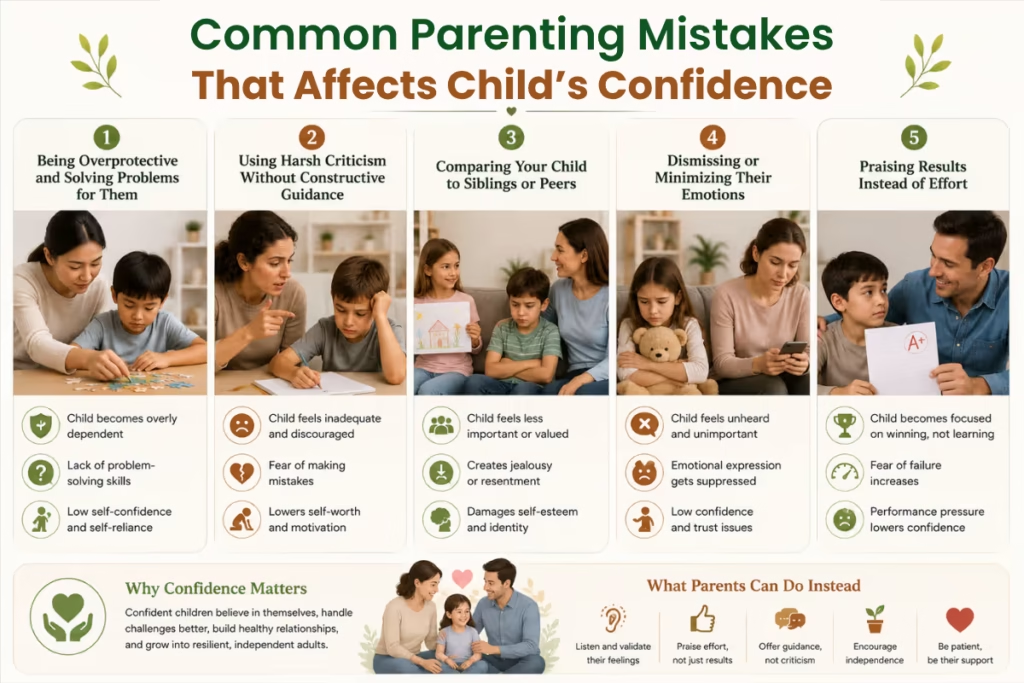
Common Parenting Mistakes That Affect a Child’s Confidence
1. Being Overprotective and Solving Problems for Them

Overprotective parenting often comes from a place of love and concern. When a child struggles, the instinct to step in and resolve the situation feels natural.
However, when this becomes a consistent pattern, it sends a quiet but powerful message to the child: you are not capable of handling this on your own.
Research published in PMC found that parental overprotection is associated with diminished self-efficacy and reduced coping behaviors in adolescents.
Self-efficacy, a child’s belief in their own ability to manage challenges, is a key building block of confidence. When parents routinely remove obstacles before a child can attempt them, that belief does not have the opportunity to develop.
A separate systematic review in Frontiers in Psychology on helicopter parenting found that when overprotection combines with a child’s low sense of competence, the risk of anxiety and depression increases.
Children begin to associate new situations with threat rather than opportunity, because they have not been given the chance to experience manageable difficulty and recover from it.
The approach that works better is to allow age-appropriate challenges. You can guide your child through a problem by asking questions, “What do you think you should try first?”, rather than providing the answer.
This positions you as a supportive presence without taking ownership of the challenge away from them.
2. Using Harsh Criticism Without Constructive Guidance

Correction is a necessary part of parenting. Children need clear feedback to understand boundaries and improve their behavior. The issue is not the correction itself; it is how the correction is delivered.
Harsh criticism, particularly when it targets a child’s identity rather than their behavior, tends to produce fear and defensiveness rather than growth. A child who hears “you never get anything right” does not receive information they can act on. Instead, they absorb a message about who they are. Over time, this type of feedback can cause a child to stop trying new things because the risk of failure feels too high.
The Child Mind Institute recommends a ratio of five positive comments for every critical one as a way to build a child’s confidence and make them more receptive to feedback when correction is necessary.
This does not mean avoiding all criticism; it means creating a foundation of encouragement that makes correction feel like guidance rather than judgment.
When correction is needed, focus on the specific behavior. “You left your homework until the last minute” gives your child something to work with. “You are irresponsible” does not. The first approach points toward a solution; the second simply reduces confidence without offering a path forward.
3. Comparing Your Child to Siblings or Peers

Comparison is one of the most common parenting mistakes that affects a child’s confidence, and one of the most well-intentioned. Parents often compare children to motivate them, to show what is possible, or to set a standard to reach. In practice, the effect is usually the opposite.
A 2025 study published in Frontiers in Psychology found that parents who engage in social comparisons tend to model and reinforce similar comparison behaviors in their children, leading adolescents to evaluate their own worth against peers rather than developing an internal sense of self-worth. When a child measures themselves against others, they are always at risk of falling short, because there will always be someone who performs better in some area.
Comparisons also affect relationships. A child who is repeatedly compared to a sibling may develop resentment, not motivation. They may also begin to feel that your approval is conditional, that they are only valued when they measure up to someone else.
A more effective approach is to compare your child only to their own previous performance. “You struggled with this last month, and now you’re getting it” builds confidence based on personal growth, not external ranking. It teaches a child that progress matters more than position.
4. Dismissing or Minimizing Their Emotions

Phrases like “you’re overreacting,” “it’s not a big deal,” or “stop crying” are common responses when a child’s emotional reaction seems disproportionate. These responses are usually meant to calm the situation. However, they often have the opposite effect, and a more lasting one.
Emotional invalidation is the dismissal or minimization of a child’s feelings, and it directly affects how a child develops their sense of self-worth. When a child’s emotions are routinely dismissed, they may begin to interpret this as evidence that their inner experience is wrong or unimportant. As a result, they lose confidence not only in expressing themselves, but in trusting their own perceptions.
Research from Psychology Today indicates that children who grow up in emotionally invalidating environments often carry feelings of self-doubt and difficulty forming healthy relationships into adulthood. The impact is not limited to childhood; it shapes how a person relates to themselves and others long after they leave home.
It is important to understand that validating your child’s emotions does not mean agreeing with their behavior or telling them their reaction was appropriate.
It simply means acknowledging what they feel. “I can see you’re really upset about this” opens the door to conversation and teaches a child that their inner experience is worth paying attention to.
5. Praising Results Instead of Effort

Praise is important for a child’s development, but the type of praise matters significantly. Many parents focus praise on outcomes, such as a good grade, a win in a competition, or a finished project. While this feels positive in the moment, it can gradually condition a child to tie their confidence to results rather than effort.
Research on this topic, including the foundational work of psychologist Carol Dweck, has shown that ability-based praise tends to produce a fixed mindset, while effort-based praise produces a growth mindset.
Children praised for being “smart” or “talented” often avoid challenges because they fear that failure will disprove that identity. In contrast, children praised for working hard or persisting through difficulty tend to choose more challenging tasks and perform better after setbacks.
A study published in ScienceDirect found that children who heard more process-based praise in early childhood showed stronger growth mindsets by second grade, which in turn predicted better academic performance in fourth grade. The effects of how you praise your child, therefore, extend well beyond the immediate moment.
You can shift this pattern by commenting on the process rather than the result. “You stuck with that even when it got difficult” or “You really worked hard on this” teaches a child that effort is what matters, and that confidence comes from showing up, not just from succeeding.
How Parenting Habits Shape a Child’s Self-Confidence?
A child’s sense of self-worth does not form in a single moment. It develops gradually through thousands of everyday interactions, such as how a parent responds when a child fails, what they say when a child succeeds, and how they react when a child expresses a difficult emotion.
Research published in Frontiers in Psychology found that parenting style and self-esteem are significantly linked, with negative parenting behaviors, such as rejection, overprotection, and emotional withdrawal, associated with lower self-esteem and poorer mental health outcomes in children and adolescents.
As Psychology Today notes, loving parents can unintentionally hurt their child’s self-esteem, often because the underlying intentions are positive, but the delivery or pattern causes harm.
Understanding which habits contribute to low confidence is, therefore, an important step in parenting more effectively. Below are five of the most common parenting mistakes that affect a child’s confidence, and what you can do about each one.
How Can You Help Rebuild Your Child’s Confidence?
Recognizing these patterns is the first step. The next step is making gradual, consistent adjustments in how you interact with your child day to day. Confidence is not rebuilt through one conversation; it develops through repeated experiences of feeling capable, heard, and valued.
What Small Daily Habits Make the Biggest Difference?
Start with three consistent practices. First, allow your child to manage age-appropriate tasks independently, even when it takes longer or they make mistakes.
Second, make a habit of naming and acknowledging their emotions before offering a solution or a correction. Third, shift your praise language to focus on effort, strategy, and persistence rather than outcomes.
These habits do not require a significant change in routine. They require a shift in attention, from what your child achieves to how they approach the process of achieving it.
How Do You Know If Your Child Is Struggling With Low Confidence?
Some signs are straightforward: your child frequently says “I can’t do this” before attempting something new, avoids activities where they might not succeed, or shows excessive self-criticism after minor mistakes.
Others are more subtle, such as reluctance to speak up in group settings or a tendency to give up quickly when a task becomes difficult.
If these patterns persist over time and begin to interfere with your child’s daily life or relationships, speaking with a pediatrician or child psychologist can be a helpful next step.
Professional support can provide both you and your child with additional strategies for building confidence in a structured way.
Building Confidence Is a Long-Term Process
Parenting mistakes that affect a child’s confidence rarely cause harm in isolation; it is the repeated pattern over time that shapes a child’s self-perception.
The important thing to recognize is that these habits can be changed. You do not need to be a perfect parent to raise a confident child. You need to be an attentive one.
Start by identifying one habit from this list that feels familiar. Work on adjusting that single pattern before moving to others. Gradual, consistent change is more sustainable than trying to overhaul everything at once.
Over time, those small shifts will create a different environment, one where your child learns to trust their own abilities and feels secure enough to face challenges with confidence.